* Numbers in brackets refer to paragraphs in the “Diary” of Saint Sr. Faustina Kowalska
Author of the photo, 2004 – Piotr Tomczyk, artist photographer, author of numerous award-winning photomontages and documentary photos, lecturer at the National Film, Television and Theatre School in Łódź, Poland.
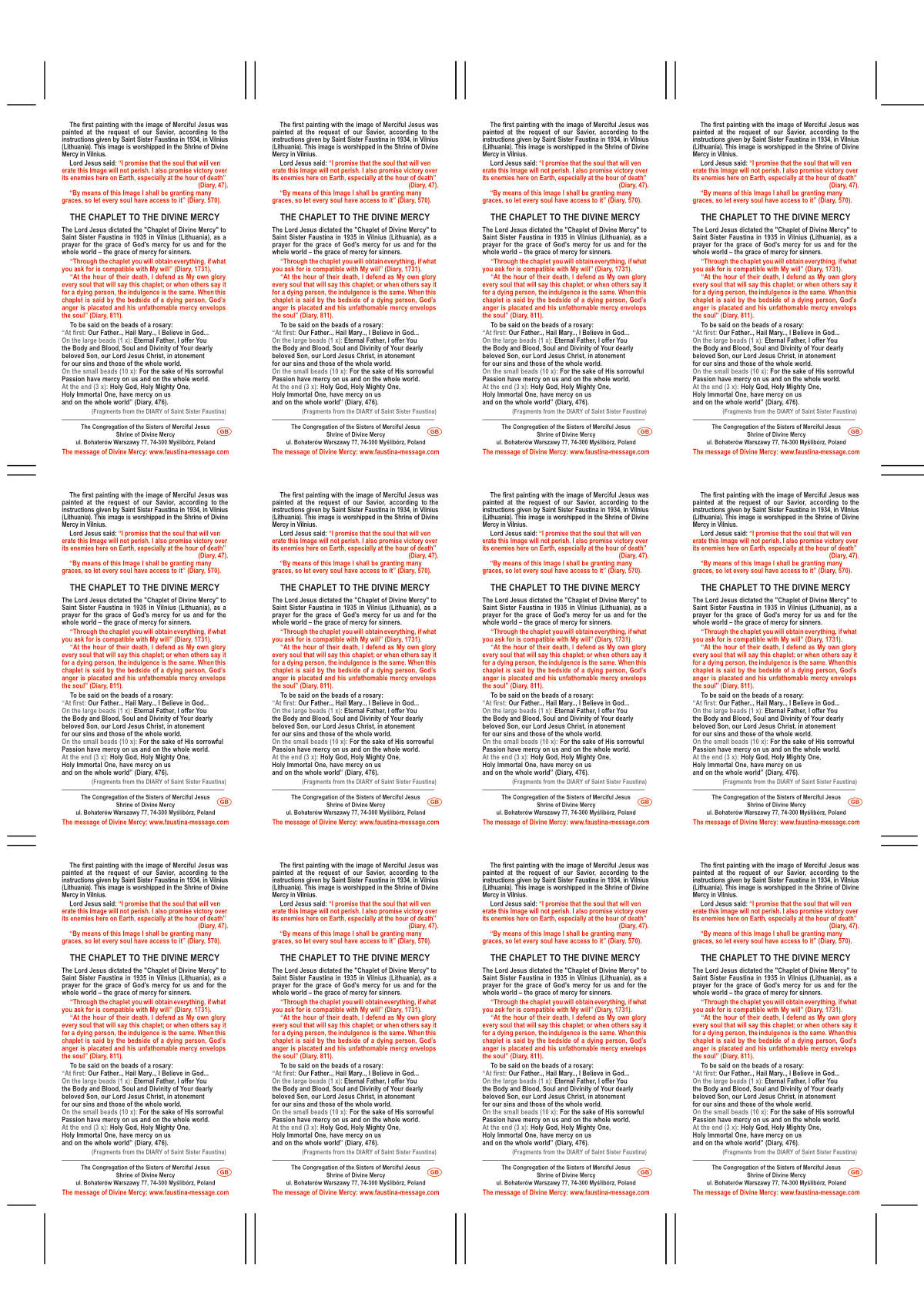
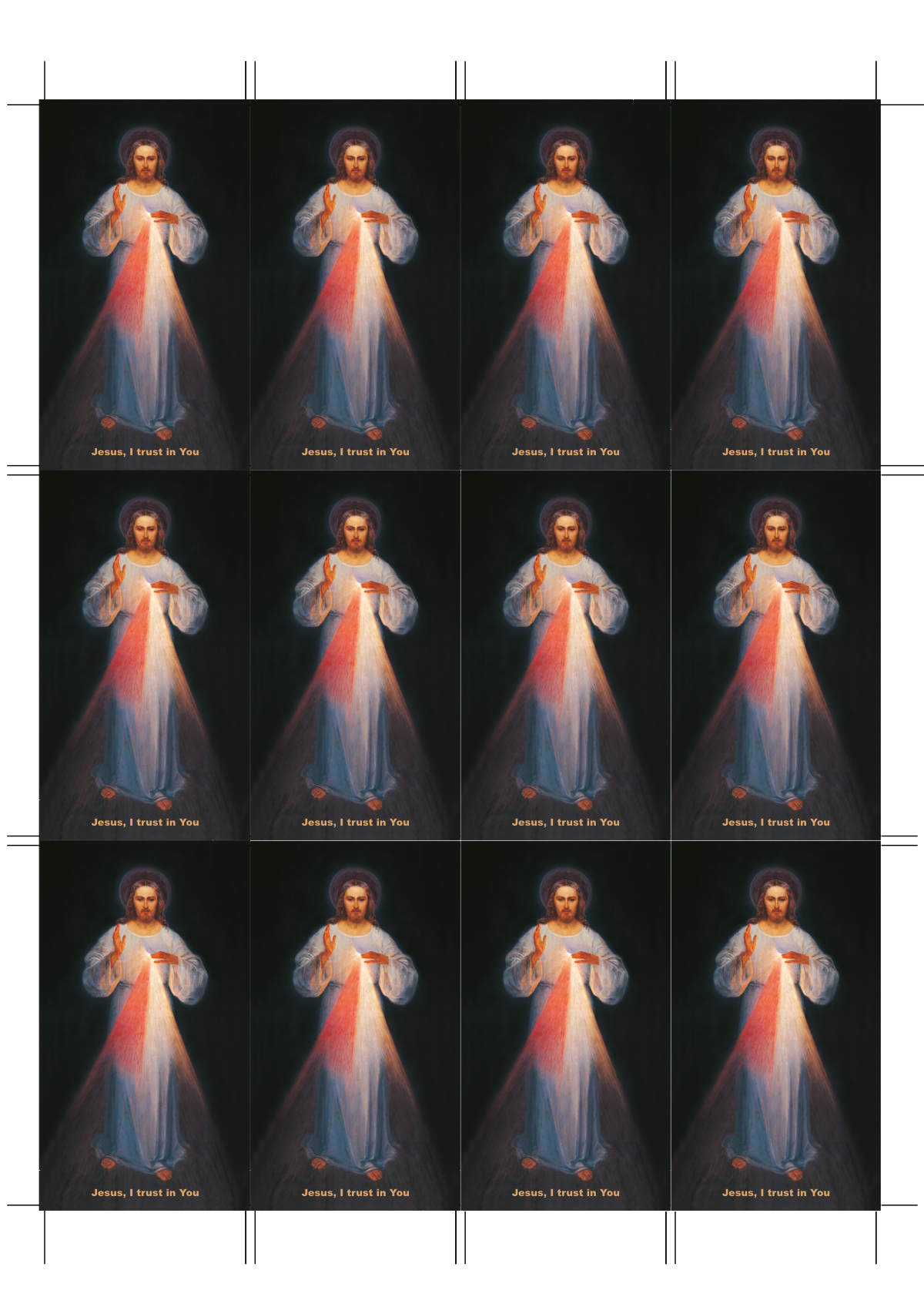
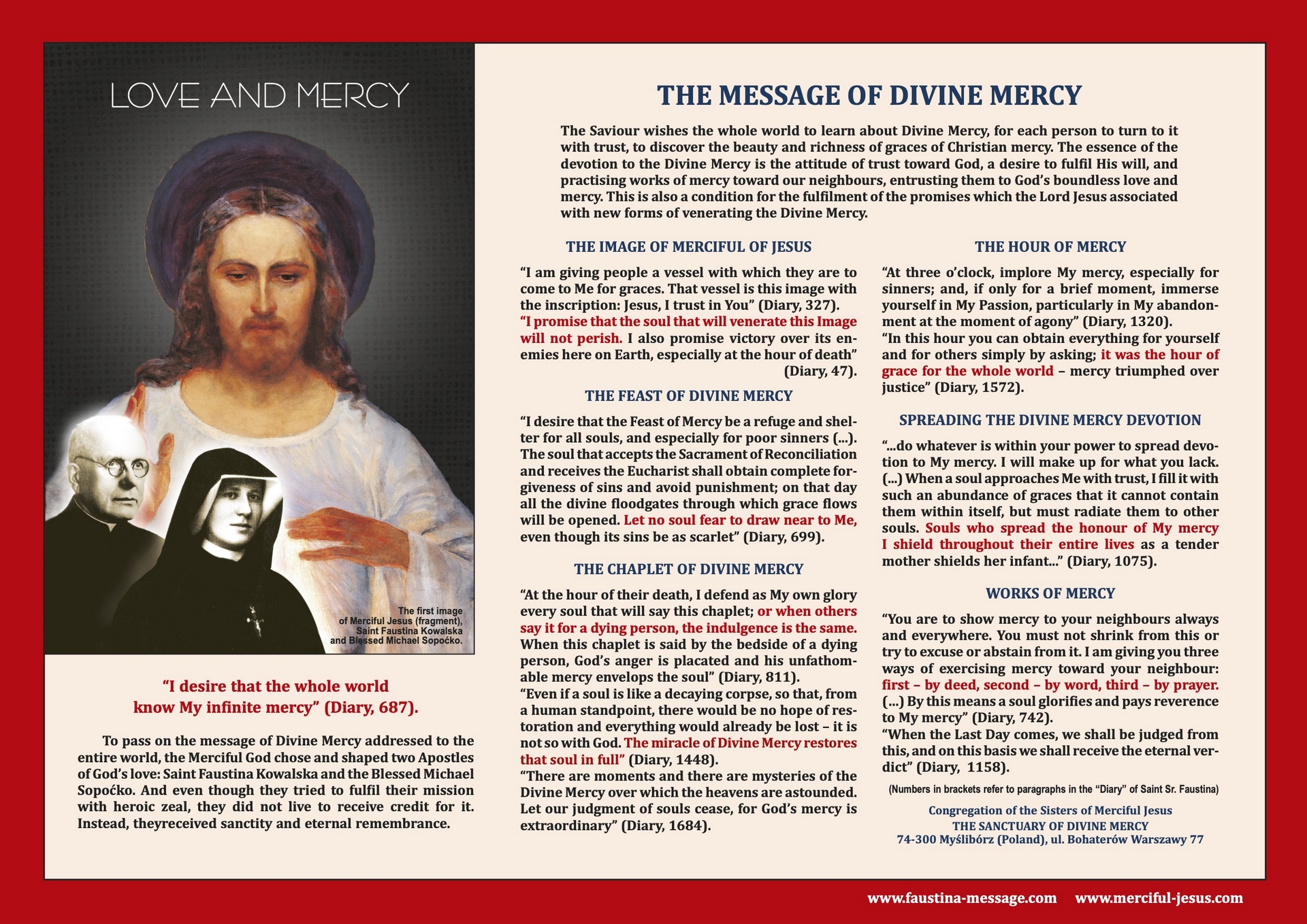
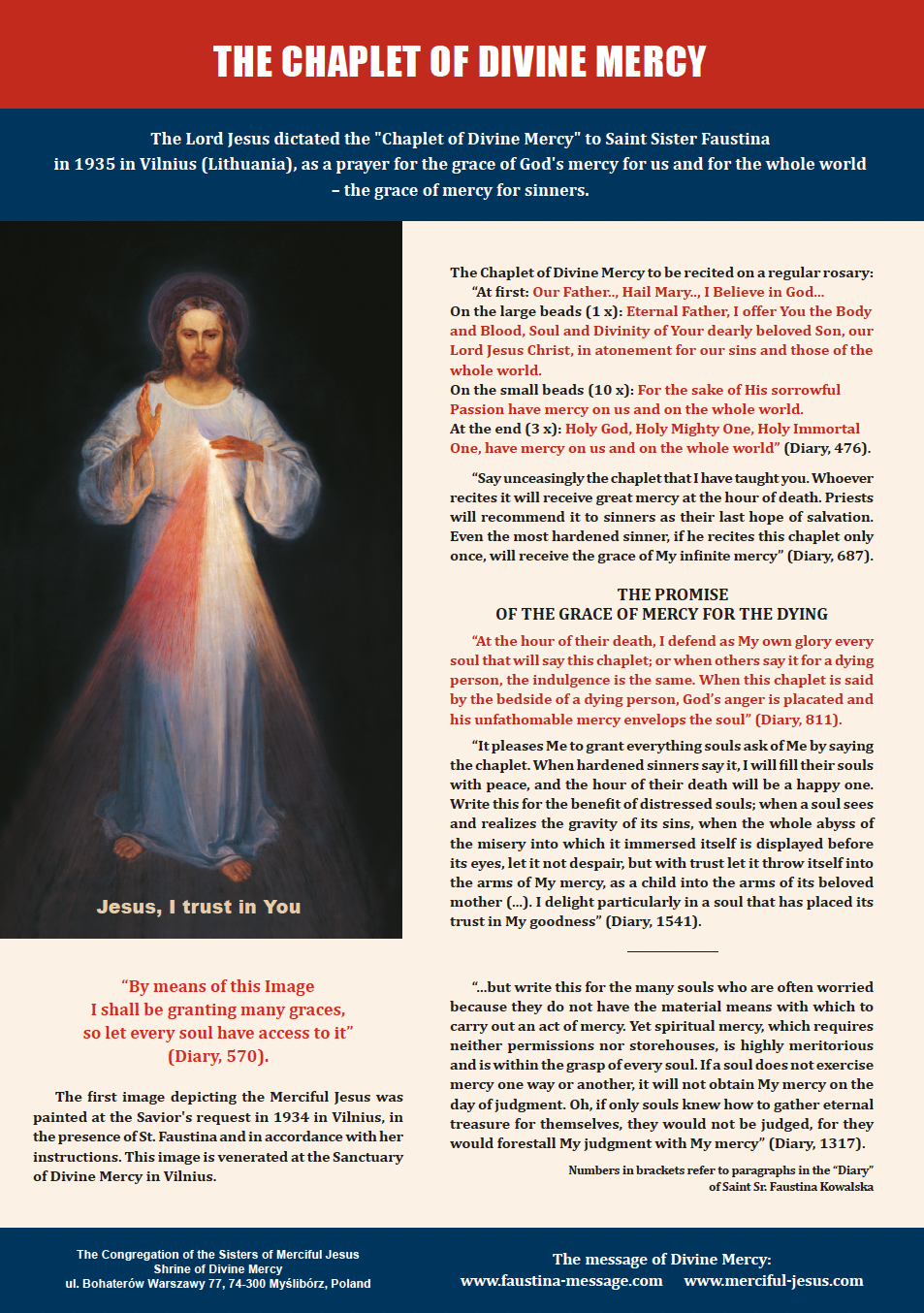
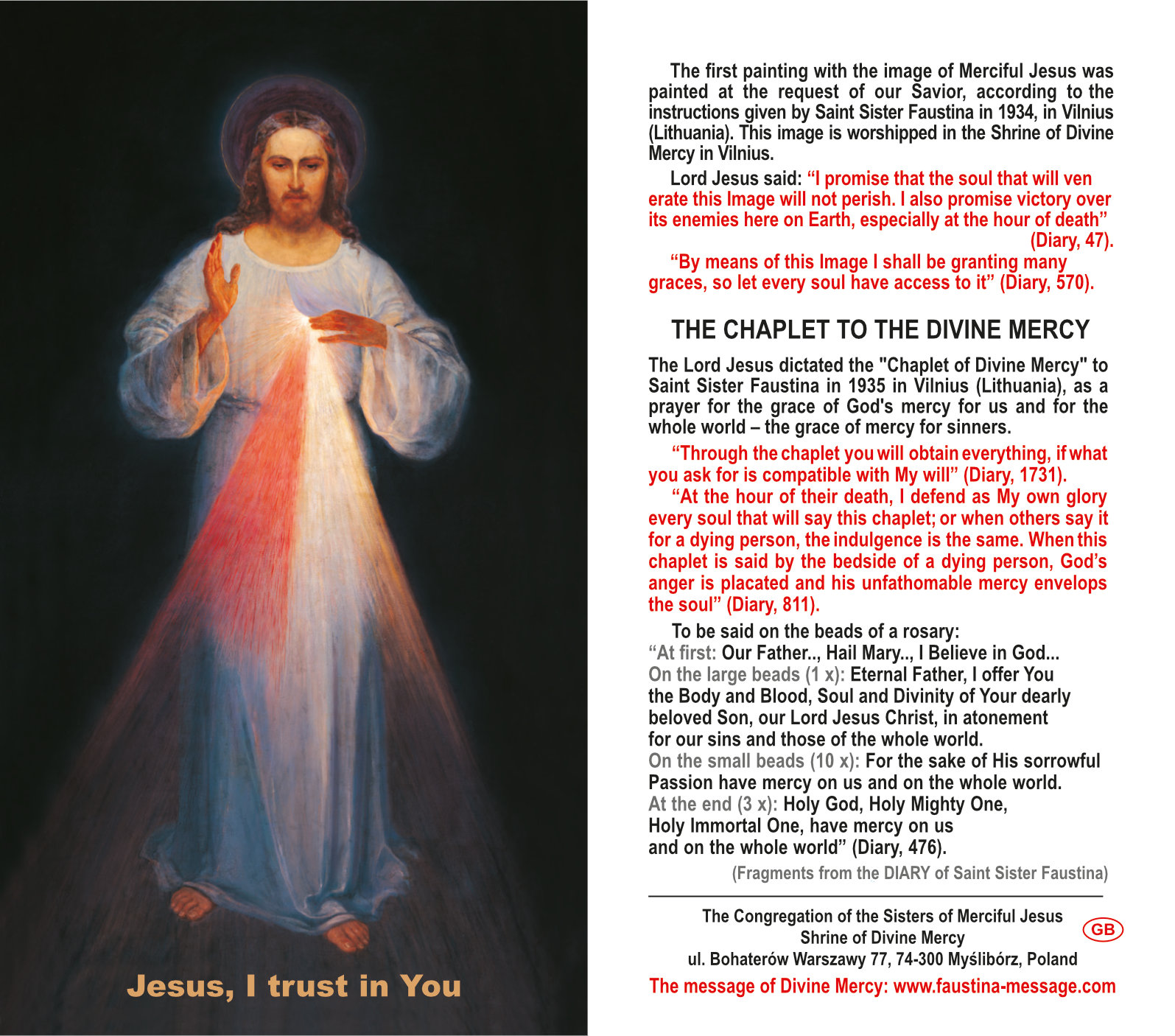
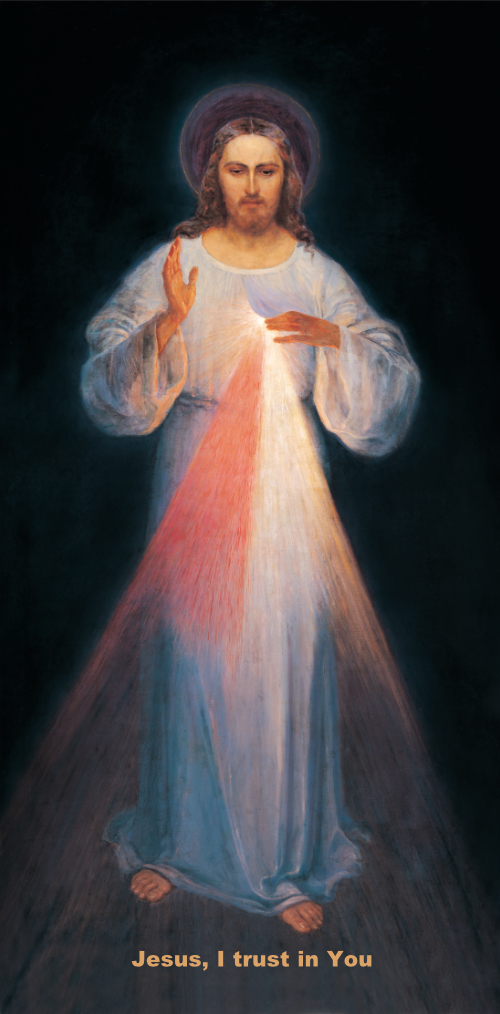
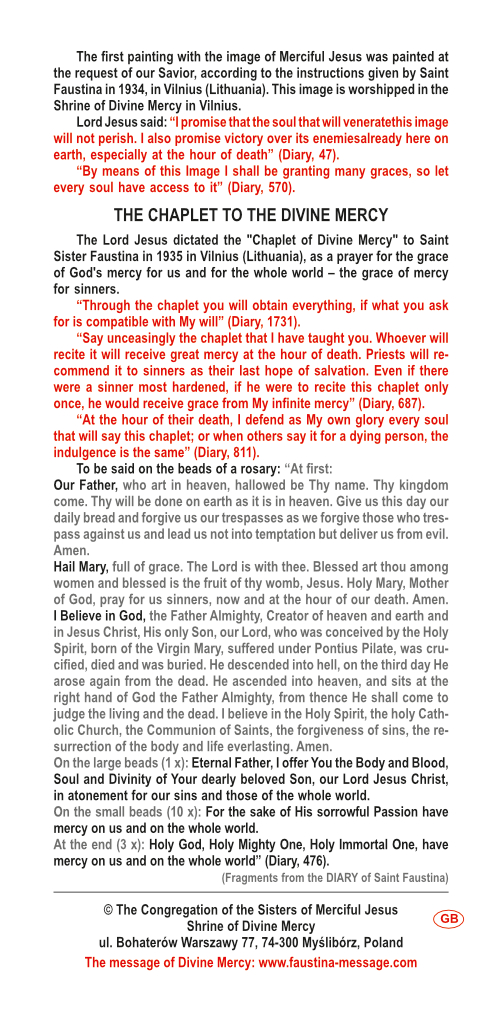
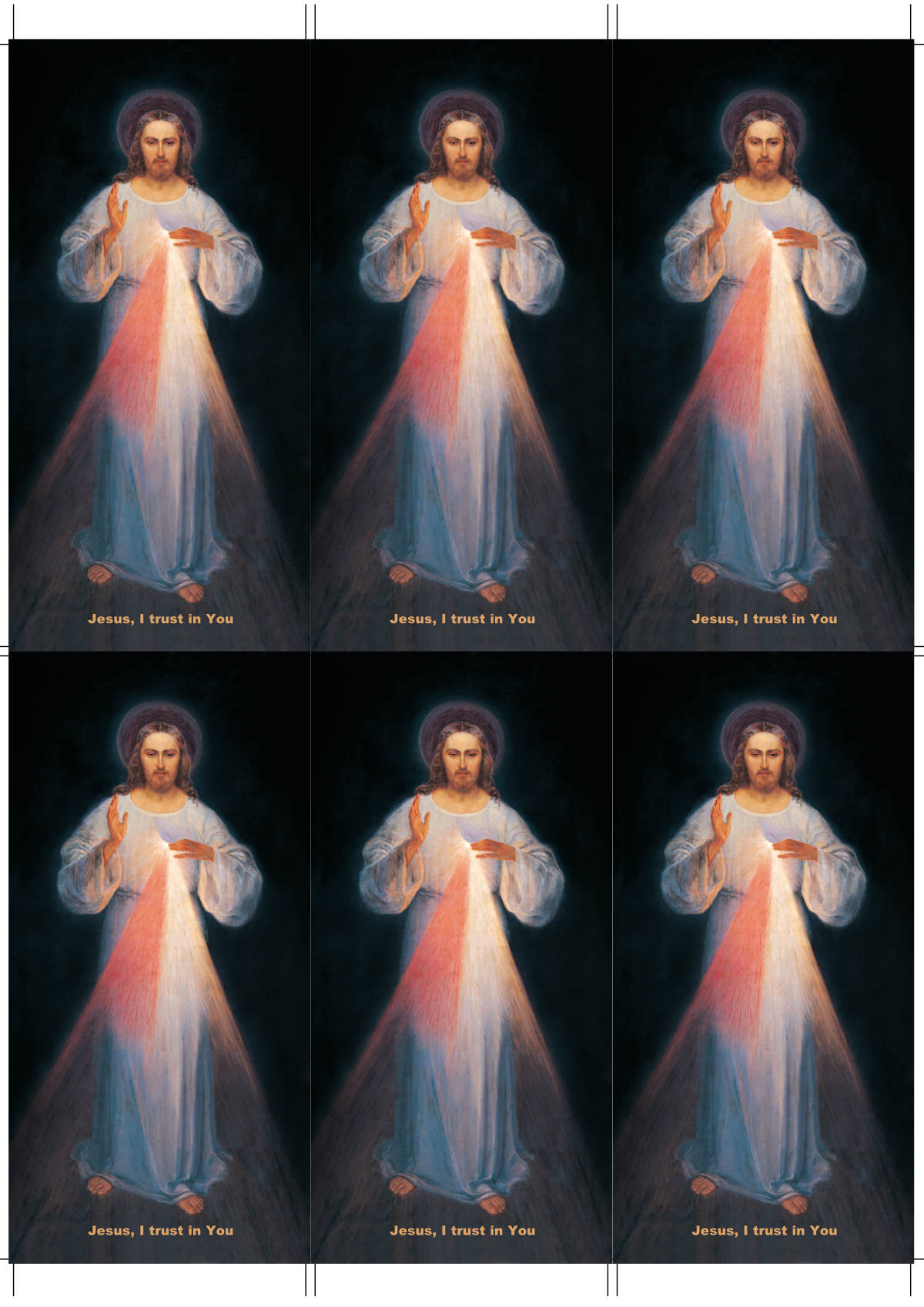
Płock [Poland] “February 22, 1931: In the evening, when I was in my cell, I saw the Lord Jesus clothed in a white garment. One hand was raised in the gesture of blessing; the other was touching His garment at the breast. From beneath the garment, slightly drawn aside at the breast, there were emanating two bright rays, one red, and the other pale. In silence I kept my gaze fixed on the Lord; my soul was struck with awe, but also with great joy. After a while, Jesus said to me: paint an image according to the pattern you see, with the inscription: Jesus, I trust inYou” (Diary, 47).
“I promise that the soul that will venerate this Image will not perish.
I also promise victory over its enemies here on Earth,
especially at the hour of death” (Diary, 47).
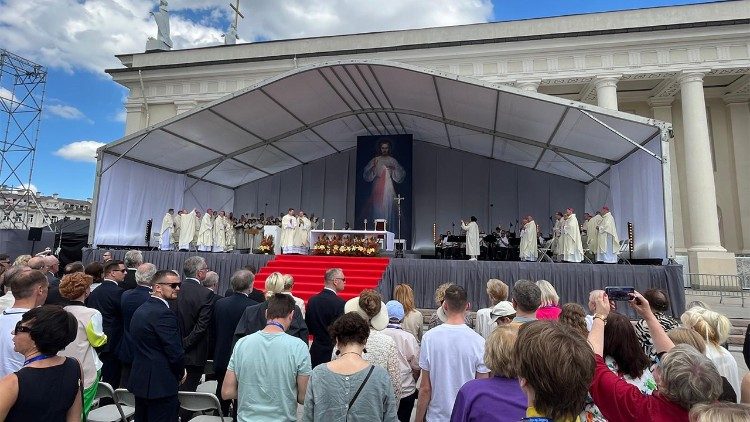
The image of the Merciful Jesus was painted at the Savior's request in 1934 in Vilnius (Lithuania), following the instructions of Saint Sister Faustina. This image is venerated at the Divine Mercy Sanctuary in Vilnius.

Divine Mercy Shrine in Vilnius (Lithuania).
Perpetual Adoration.
On April 26-28, 1935, In Vilnius, the image of the Merciful Saviour was venerated publicly for the First time during the festive ceremony ending the Jubilee of the 1900 th anniversary of the Redemption of the World. It was displayed in a window of the gallery next to the Chapel of Our Lady of Mercy (Ausros Vartai). On the final day of the celebrations – it was the first Sunday after Easter – the service was attended by Sr. Faustina. The homily on the Divine Mercy was delivered by Fr. Sopoćko, just as requested by the Lord Jesus.
"...I heard a sermon given by my confessor. This sermon about Divine Mercy was the first thing that Jesus had asked for so very long ago. When he began to speak about the great Mercy of Our Lord, the image came alive and the rays pierced the hearts of the people gathered there..." (Diary, 417)
“Toward the end of the service, when the priest took the Blessed Sacrament to bless the people, I saw Our Lord Jesus as He is represented in the image. Our Lord gave His blessing, and the rays extended over the whole world...” (Diary, 420).
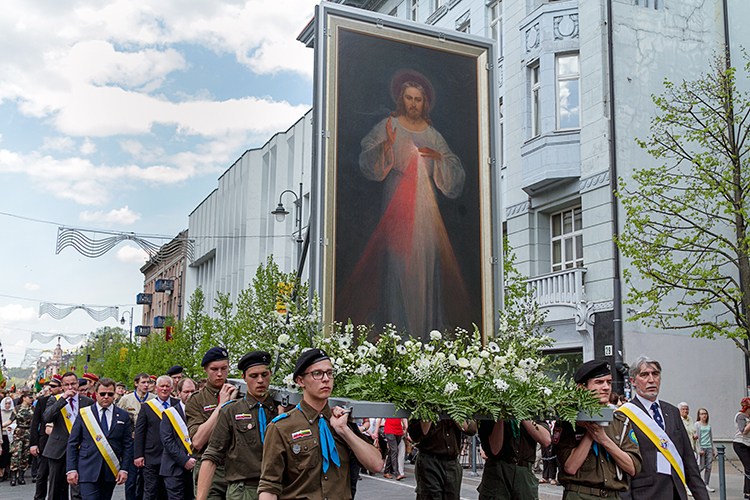
During his pilgrimage to Lithuania, on September 5, 1993, Pope John Paul II prayed before the image of the Merciful Jesus. In his address to the faithful, he called this painting the "HOLY IMAGE."
In In the history of the apparitions, only one event is known when the Lord Jesus expressed his will to paint his picture. He himself presented and accepted his artistic image – as evidenced by his vivid presence, repeatedly shown to Sr. Faustina in a painted picture. Moreover, by promising the worshipers of this image special favors, he gave it an extraordinary religious value.
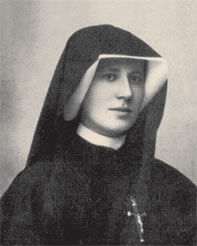
The Lord Jesus gave Sister Faustina, a Polish nun from the Congregation of Our Lady of Mercy, an extraordinary mission – the Message of Mercy addressed to the whole world. Her mission was to deliver new prayers and forms of devotions to the Divine Mercy, which are to remind us about the forgotten truth of faith: the merciful love of God for every person. In His message, the merciful God manifests Himself in Jesus Christ, the Saviour, as a Father of love and mercy, especially for the unfortunate, the errant and sinners – wanting to change their lives.
“This is the visible help for you on Earth.
He will help you to carry out My will on Earth” (Diary, 53).
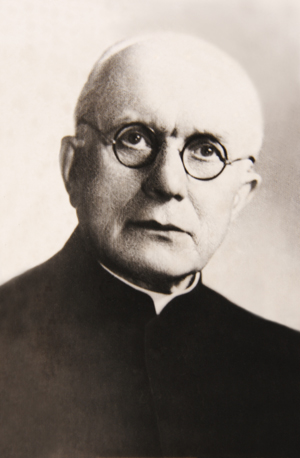
In Saint Faustina’s mission, Divine Providence entrusted a special role to her confessor and spiritual director – Father Michael Sopoćko. He was of crucial assistance to Sister Faustina, helping her to understand her inner experiences and visions. At his request she wrote the Diary, which is a document of Catholic mysticism of extraordinary value. The Diary also presents the sanctity of Michael Sopoćko’s priestly life and his contribution to fulfilling the desires of the Lord Jesus.
“He is a priest after My own Heart; his efforts are pleasing to Me
(...) Through him it pleases Me to proclaim the worship of My mercy” (Diary, 1256).
The painting of the image of the Merciful Jesus, its public display, the dissemination of the Chaplet of Divine Mercy, the initial efforts to establish the Feast of Mercy, and the founding of a new religious congregation all took place in Vilnius thanks to the efforts of Father Sopoćko. Since then, their joint efforts, paid for with prayer and suffering, have radiated throughout the world.
In his more than two hundred scientific publications, numerous press publications and delivered conferences, Father Dr. Michael Sopoćko developed theological foundations for new forms of the worship of Divine Mercy,devotion which he fervently promoted through his engagement in evangelization and social activities.
„I saw two enormous pillars planted in the ground; I had planted one of them, and a certain person, S. M. (Sopoćko M.), the other. (...). These two pillars were close to each other, in the area of the Image. And I saw the Image, raised up very high and hanging from these two pillars. In an instant, upon these two pillars, supported both from inside and outside, there stood a large temple. I saw a hand finishing the temple, but I did not see the person doing so...” (Diary, 1689).
„Surely
everything comes from the Merciful Jesus, but all the
graces we are granted come to us through Mary. It was not a
coincidence that the picture of the Most Merciful Saviour, enjoying
worship and granting graces all over the world, was originally
displayed at the foot of the Our Lady of Mercy in Vilnius, April 28,
1935, the first Sunday after Easter [Feast of Mercy] – one might
say for her to approve and recommend it” (Fr. Michael Sopoćko).
“Mankind will not have Peace until it turns with trust to My mercy” (Diary, 300).



The Lord Jesus dictated the "Chaplet of Divine Mercy" to Saint Sister Faustina in 1935 in Vilnius (Lithuania), as a prayer for the grace of God's mercy for us and for the whole world
– the grace of mercy for sinners.
“At the hour of their death, I defend as My own glory every soul that will say this chaplet; or when others say it for a dying person, the indulgence is the same. When this chaplet is said by the bedside of a dying person, God’s anger is placated and his unfathomable mercy envelops the soul” (Diary, 811).

Fragment of the foreword, Grzegorz Ryś Metropolitan Archbishop of Łódź, Poland:
"I am
deeply convinced that the excerpts from the “Diary” of the Saint Sister Faustina
and fragments of the publications of the Blessed Father Sopoćko included
in the book will contribute to discovering and accepting the Message of
Divine Mercy, which becomes the kerygma for the third millennium. Reading
these texts makes us realize that God shows incredible determination in
repeating that He is Mercy – an unconditional love, completely undeserved
by us, precedent to any of our good deeds".

The testimony shows extraordinary circumstances and documented facts about how, through an aroused desire to fulfill God's will, God can enable us to perform actions that amaze, surpass, and surprise us, especially when, having nothing, we receive everything we need at a given moment.
The works presented in the testimony were accomplished thanks to the cooperation of the devotees of Divine Mercy from the prayer group of the Renewal in the Holy Spirit at the Jesuit Church in Łódź (Poland) and the involvement of the Superior General (at that time) of the Congregation of the Sisters of Merciful Jesus, Sister Maria Kalinowska – her spiritual guidance and assistance in the implementation of the works presented.
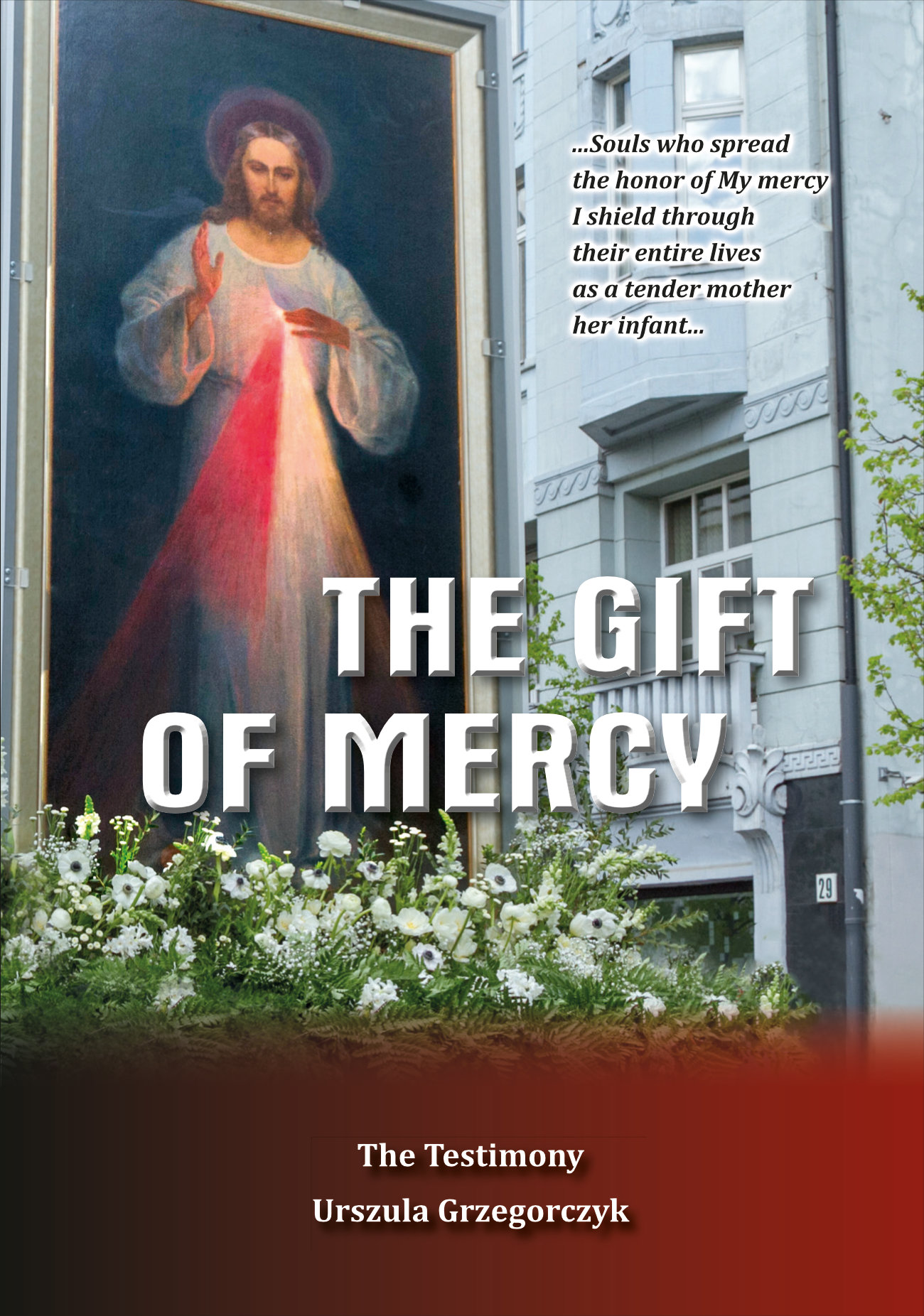
Urszula Grzegorczyk initiated, organized, and commissioned the restoration of the first image of Merciful Jesus in Vilnius in 2003, and also arranged a professional photo shoot in 2004. The
large-format slide obtained then, scanned with a drum scanner into a digital file with the image,
she made in 2009 available for printing and general evangelization. One of the slides obtained in 2004 was donated to the Congregation of Marian Fathers in Stockbridge, USA.
The restoration of the image took place in the chapel of the Congregation of the Sisters of
Merciful Jesus in Vilnius (more information in the testimony)
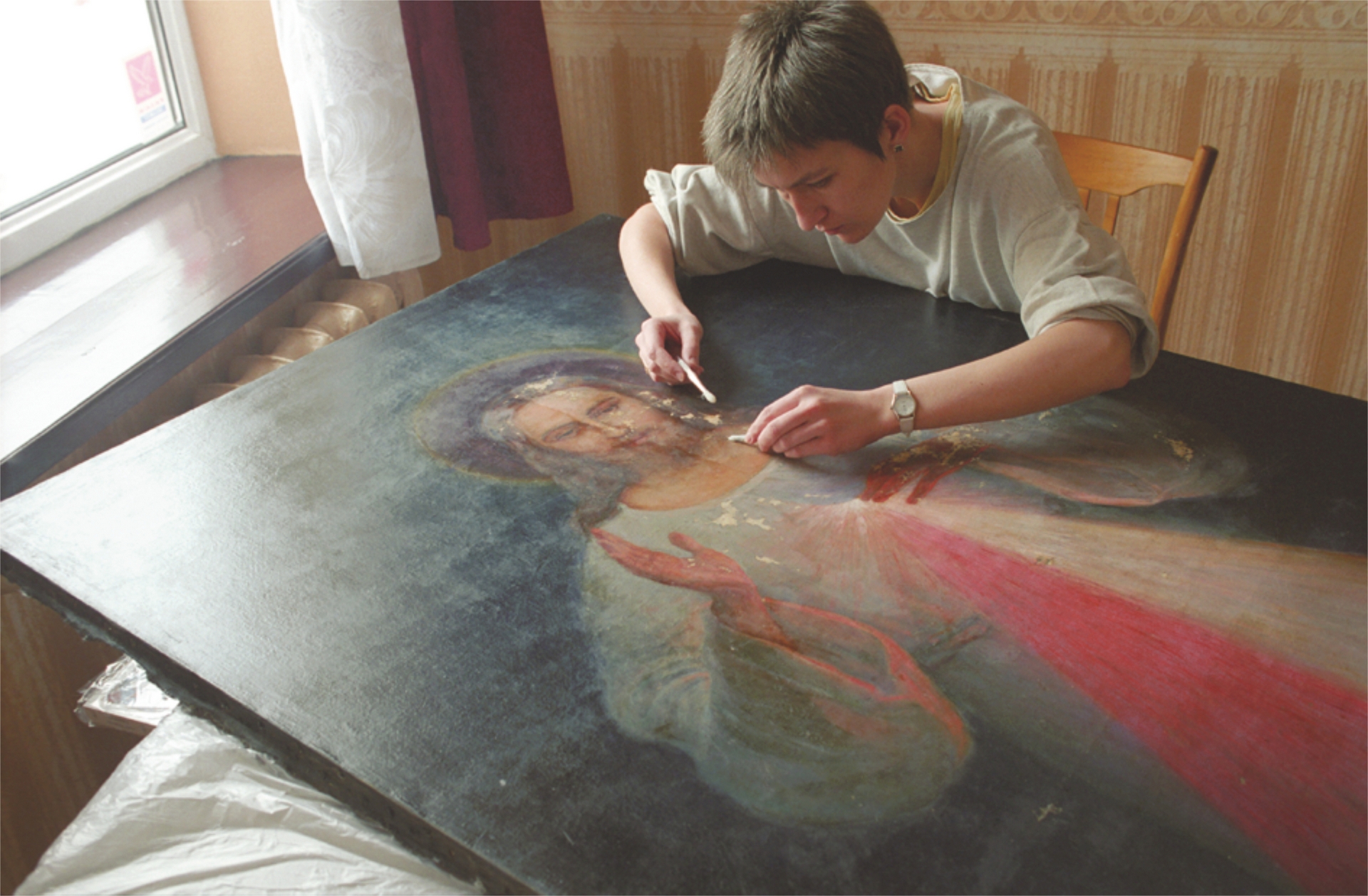
The restoration of the first image of Merciful Jesus was carried out in 2003 by Edyta Hankowska-Czerwińska of Włocławek, an art restorer, graduate of the Faculty of Fine Arts at the Nicolaus Copernicus University in Toruń (Poland).
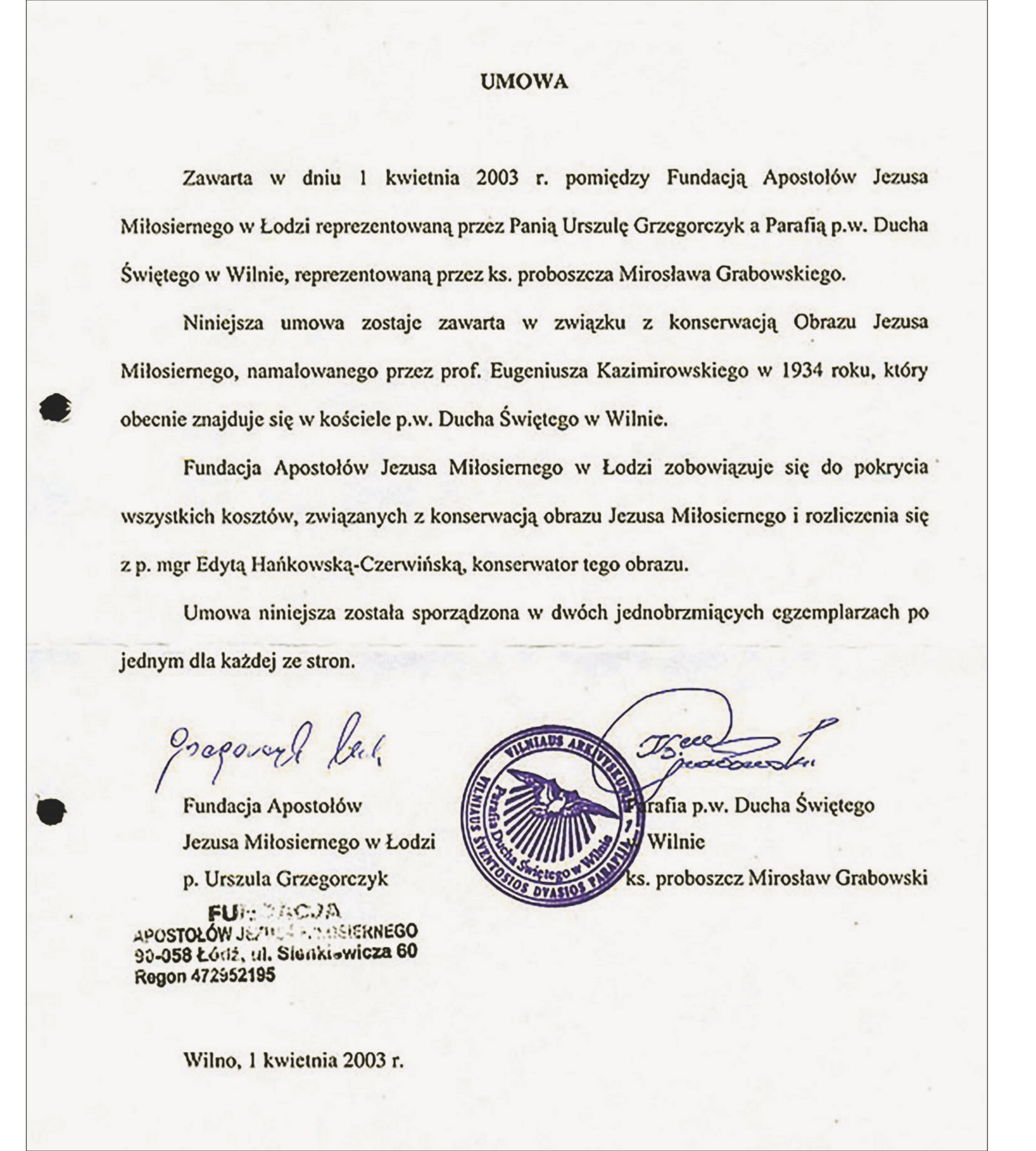
Contract
Concluded on April 1, 2003 between the Foundation of the Apostles of the Merciful Jesus in Łódź represented by Mrs. Urszula Grzegorczyk and the Holy Spirit Parish in Vilnius represented by the parish priest Mirosław Grabowski.
This contract has been concluded with regard to the conservation of the Painting of the Merciful Jesus, painted by prof. Eugeniusz Kazimirowski in 1934, and which at present is located at the church of the Holy Spirit in Vilnius.
The Foundation of the Apostles of the Merciful Jesus in Łódź undertakes to cover all costs with regard to the conservation of the painting of the Merciful Jesus and to clear all the costs with Mrs. Edyta Hańkowska-Czerwińska, MA, the restorer of the painting.
The contract was made in two counterparts, one for each party.
[stamps and signatures]
Vilnius, April 1, 2003

Message of Divine Mercy :